Dr. Gabriel Woods — Organizational Intelligence for Educational Institutions

Helping educational institutions
solve complex leadership,
governance, enrollment,
and organizational performance
challenges.

Leadership turnover is one of the most overlooked organizational risks facing educational institutions today. Most institutions measure activity. ISEE measures what actually drives outcomes.

ISEE helps educational institutions identify organizational risks and improve leadership, retention, governance, and performance through data-informed strategy and systems thinking.

K-12 and higher education institutions are making consequential decisions every day without an accurate picture of what is actually driving their outcomes. Board conflict. Teacher departure. Budget misalignment. Leadership instability. These are not management failures. They are organizational intelligence failures. ISEE diagnoses exactly what is driving them and delivers written findings within 72 hours.

Superintendents and institutional leaders were hired to lead. Instead they are navigating board conflict, budget pressure, and staff departures without an independent organizational picture of what is driving any of it. That is an organizational intelligence problem. ISEE solves it.

62%
of superintendents say inadequate financing limits their effectiveness (AASA 2025)
23%
superintendent turnover rate in the nation's 500 largest districts (Supt. Research Project 2025)
72hrs
preliminary organizational intelligence delivered after every engagement
$3.2B
annual cost of board conflict and governance instability nationwide (NSBA 2024)
Superintendent turnover costs districts $50,000 to $150,000 per departure. Teacher vacancies cost $12,000 to $25,000 each. Across decades of combined practitioner experience, the ISEE team has observed the same governance conditions driving these outcomes in institution after institution. In one school district where the primary condition was directly addressed, leadership stability was restored and the superintendent search that followed was completed in 90 days.
Organizational IntelligenceBoard GovernanceSuperintendent Support Leadership ClarityStrategic AlignmentTalent Intelligence Teacher RetentionExpenditure AlignmentResults Orientation AI ReadinessEvery DistrictStudent Achievement Organizational IntelligenceBoard GovernanceSuperintendent Support Leadership ClarityStrategic AlignmentTalent Intelligence Teacher RetentionExpenditure AlignmentResults Orientation

ISEE is a practitioner-led educational intelligence firm. Organizational dysfunction costs K-12 districts $8 to $10 billion annually in turnover, governance conflict, and misaligned spending. ISEE diagnoses and addresses it.

Practitioner-Led
Every engagement led by doctorate-level educators and senior practitioners with decades of combined experience inside K-12 and higher education institutions
Research-Grounded
Every recommendation sourced to peer-reviewed research, AASA national data, and verified educational leadership practice
Education-Exclusive
ISEE serves only K-12 and higher education institutions. Never corporate clients. Never generic frameworks
The Problem

Most institutions are led by capable people
making decisions without complete organizational intelligence.

The gap between what your institution intends and what it actually produces is almost never a gap in leadership quality. It is a gap in organizational intelligence. And it costs students first.

Scenario 1

"We have hired three superintendents in five years and cannot understand why none of them last."

The departure pattern is an organizational condition, not a hiring failure. Each departure costs the district $50,000 to $150,000 in search fees and organizational disruption before a new leader takes a single action. ISEE identifies the governance, accountability, or cultural dynamics producing the instability before the next hire walks in the door.

Scenario 2

"Our strategic plan says one thing and our budget says something completely different."

Between 15 and 25 percent of district budgets fund programs that cannot demonstrate measurable impact. In a $20 million district that is $3 to $5 million per year funding inertia rather than outcomes. ISEE identifies every misaligned allocation and what should replace it.

Scenario 3

"Our teachers are leaving and nobody can tell us why, or what to do about it."

Teacher departure is always an organizational signal. Each vacancy costs the district $12,000 to $25,000 in replacement costs alone — before calculating the impact on student continuity and learning. ISEE diagnoses the conditions driving departure before they produce the next vacancy.

Who We Help

School Boards
Superintendents
College Presidents
Provosts
Deans
State Education Agencies
Charter Organizations
Educational Nonprofits

The ISEE Framework

01
Assess
Listen. Observe. Gather intelligence.
02
Analyze
Diagnose conditions. Identify root causes.
03
Align
Connect findings to strategy and priorities.
04
Act
Deliver specific actionable recommendations.
05
Measure
Track progress. Follow up at 90 days.
Who We Serve

Built for educational leaders
who carry more than they should carry alone

K
K-12 School Districts

Superintendents and boards navigating governance complexity, teacher retention crises, budget misalignment, and the organizational conditions that determine whether student outcomes improve or stagnate. Organizational dysfunction does not stay in the boardroom. It moves through buildings, into classrooms, and into the achievement gaps your community is waiting for you to close.

  • Board governance and superintendent relationship intelligence
  • Teacher retention and talent deployment diagnostics
  • Strategic plan and budget alignment analysis
  • Leadership transition organizational readiness
  • AI organizational readiness assessment
H
Higher Education Institutions

Provosts, deans, and presidents navigating faculty governance complexity, enrollment pressure, accreditation readiness, and the institutional culture conditions that determine whether a campus community achieves its stated academic mission. The ISEE team brings practitioner knowledge that only comes from having served inside these institutions.

  • Presidential and provost transition support
  • Academic program alignment and outcome analysis
  • Accreditation readiness intelligence
  • Faculty and staff culture diagnostics
  • Enrollment strategy and retention alignment
H
HBCUs and Minority-Serving Institutions

HBCUs and Minority-Serving Institutions carry an irreplaceable mission in American higher education. The organizational intelligence challenges they navigate are specific, complex, and consequential. ISEE brings practitioner knowledge, cultural competence, and diagnostic rigor to these institutions with the same professional standard the team brings to every engagement.

  • Presidential leadership and governance intelligence
  • Institutional identity and mission alignment
  • Resource and financial health diagnostics
  • Community and alumni trust intelligence
  • Enrollment and persistence strategy

"The boards and superintendents we work with are not lacking in commitment or capability. They are lacking independent intelligence about their own organizations. That is what the ISEE team provides. And with it, everything changes."

ISEE, LLC, Systems Intelligence for Educational Organizations

Four Flagship Engagements

01 — Board Governance Assessment

Independent assessment of governance conditions, board-superintendent alignment, and the organizational dynamics driving leadership instability. ISEE is the team school boards call before a leadership crisis becomes a leadership departure.

02 — Superintendent Transition and Retention Assessment

Diagnoses the specific organizational conditions that predict superintendent departure before it happens. Prepares institutions for leadership transition and identifies what must change for the next leader to succeed.

03 — Teacher Retention Intelligence Review

Identifies the building-level and institutional conditions driving teacher departure before the next vacancy occurs. Delivers a specific action plan for the organizational changes that improve retention.

04 — AI Readiness Assessment

Examines whether your institution is organizationally ready to adopt AI before another dollar is spent on tools your organization cannot yet use. Written readiness report, board scorecard, and 30-60-90 day action plan.

Higher Education Practice

If you are a president, provost, or dean,
ISEE understands your world.

Most K-12 consultants cannot speak credibly to higher education. Most higher education consultants cannot speak credibly to K-12. ISEE bridges both because the team has worked inside both systems at every level — from classroom to cabinet to board room.

The team has written undergraduate degree programs, worked in accreditation environments, served across the University System of Georgia, and mentored faculty and emerging academic leaders. When a provost or president sits across from ISEE, they are not talking to someone who learned about higher education from a textbook.

We help colleges and universities improve enrollment, retention, leadership effectiveness, and organizational performance through data-informed strategy, systems thinking, and emerging technologies.

Enrollment and Retention Intelligence

Which students are leaving and why. Which populations are most at risk. What organizational conditions are driving attrition. A specific action plan for what must change first.

Academic Program Portfolio Review

Which programs should grow. Which should be redesigned. Which should be sunset. A strategic analysis grounded in enrollment data, workforce demand, and institutional mission.

Faculty and Leadership Development

New chair development. Dean onboarding. Faculty leadership academies. Emerging leader programs. Built by practitioners who have led inside these institutions.

AI Strategy for Universities

What should your AI policy be. How should faculty and administrators use AI. How does AI affect student success. ISEE delivers answers grounded in organizational readiness not vendor promises.

Our Philosophy

Students and communities first.
Always.

ISEE was not built by business school graduates who discovered the education market. It was built by practitioners who have spent their careers inside classrooms, administrative offices, faculty senates, and board committee rooms across K-12 and higher education, not observers from the outside looking in.

This distinction matters because the organizational dynamics of a K-12 school district are fundamentally different from those of a corporation. Boards are elected, not appointed. Superintendents serve at the board's pleasure. Teachers are unionized. Budgets are public. Every decision is made in a political environment where community trust is the most fragile and most valuable organizational asset.

ISEE builds its methodology around these realities, not around frameworks borrowed from corporate consulting and applied without modification to educational institutions. The result is organizational intelligence that leaders can actually use.

54%
of superintendents say finance consumes most of their time
AASA 2025
44%
report personnel management as a top time consumer
AASA 2025
41.1%
of superintendent time consumed by board relationships
AASA 2025
17.8%
list fiscal management as a top personal strength
AASA 2025

All statistics: AASA 2025 American Superintendent Study, Mid-Decade Update. Full citation library available upon request.

Board Intelligence

When school boards cannot see
what they need to govern effectively

The ISEE team supports boards in doing governance work with greater clarity, stronger evidence, and deeper organizational insight than any board can develop on its own. Our role is not to evaluate board members. It is to give boards the organizational intelligence they need to govern with confidence and build the board-superintendent partnership that produces results for students.

Board governance quality is one of the strongest organizational predictors of student achievement outcomes. The gap between what an institution intends for its students and what those students actually experience almost always traces to an organizational condition the board has the power to address. ISEE makes that gap visible.

01. Governance Decision Analysis

ISEE documents how boards arrive at decisions, what information they draw upon, and where consistent blind spots appear in the governance process.

02. Leadership Evaluation Infrastructure

ISEE assesses whether the systems boards use to evaluate superintendent performance are rigorous, consistent, and aligned with institutional outcomes.

03. Board-Superintendent Alignment

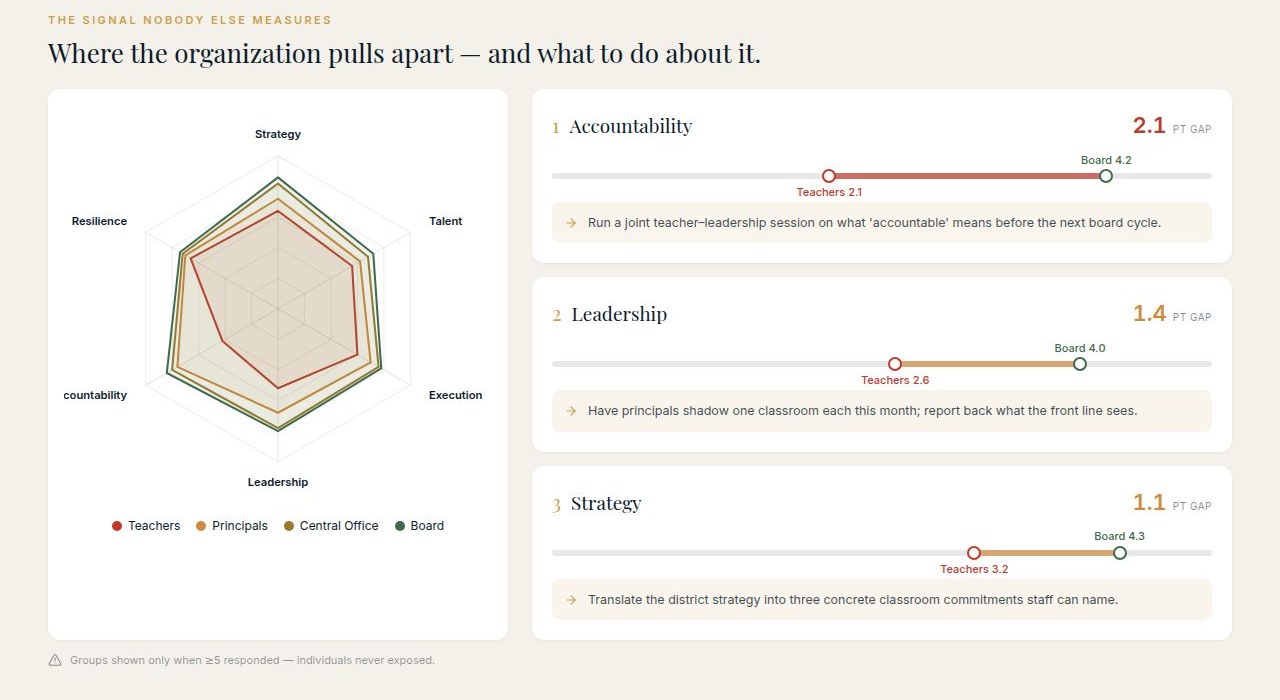
ISEE administers parallel assessments to board members and the superintendent separately, cross-referencing results to identify governance alignment gaps.

04. Organizational Readiness for Leadership

ISEE prepares the organization for new leadership to succeed, examining the structural, cultural, and governance conditions the next leader will inherit.

Our Approach

Organizational Intelligence.
Delivered With Precision.

Most institutions are navigating organizational challenges that are costing them money, talent, and student outcomes every day they go undiagnosed. The ISEE team delivers the organizational intelligence that names those challenges precisely, documents them rigorously, and gives leadership a specific actionable plan within 72 hours of data collection. Not training programs. Not compliance checklists. Not generic plans. Intelligence.

Every engagement is scoped through a direct conversation with leadership. The depth, the timeline, and the deliverables are determined by what the institution needs, not by a service menu.

If the answer almost never begins in the classroom, it almost always begins in the organizational conditions surrounding it. ISEE finds those conditions and tells you exactly what they are.

Why Industrial Engineering

Industrial Engineers do not fix individual parts. They examine how the entire system produces its output. ISEE does not fix individual teachers or principals. It examines how the entire organizational system produces or prevents student outcomes.

The STELAR Framework™ is a systems diagnostic. The 72-hour promise is a process performance standard. Expenditure Alignment is Lean waste elimination. Results Orientation is quality control.

The Methodology

ISEE applies a proprietary organizational diagnostic methodology developed through engagements with K-12 and higher education institutions. Every element is designed to support leadership decision-making, not to evaluate or judge the leaders themselves.

The methodology is earned through the engagement, not explained on a website.

C
Conversation
Every engagement begins with a 30-minute conversation. No commitment required. An honest exchange about where your institution is and where the ISEE team can help.
D
Diagnosis
Structured executive interviews in person. Building-level staff engagement. Document and systems review. ISEE applies its proprietary methodology across every critical dimension of organizational health.
I
Intelligence
Preliminary findings delivered within 72 hours of data collection closing. Full written report with a 30-60-90 day action framework. Executive briefing to leadership in person.
A
Action
Every ISEE engagement includes a 30-60-90 day action framework and a 90-day follow-up conversation with leadership. The engagement ends when leadership has the clarity and support to move with confidence.
72
Hour Promise

Within 72 hours of data collection closing every ISEE client receives a written Preliminary Findings Memo with priority flags, organizational health scores, and documented strengths. Speed of intelligence is a professional obligation, not a feature.

Our Story

The organizational conditions
surrounding students determine their outcomes.

I spent multiple decades inside American public education. As an educator, administrator, department chair, hearing officer, board committee member, and institutional leader across K-12 and higher education.

I am a Georgia State University alumnus. The story Andrew Gumbel tells in Won't Lose This Dream about how GSU transformed outcomes for students from every background by diagnosing and removing the organizational obstacles in their way is not an abstract case study to me. It is the story of my own institution. And it confirms what I observed across multiple decades working inside these organizations. The conditions surrounding students determine their outcomes more than almost anything else.

I sat in rooms where capable leaders were blamed for outcomes produced by conditions they inherited and never had the tools to diagnose. I watched institutions spend millions on programs that failed not because the programs were wrong but because the organizational conditions surrounding them were never examined. Teachers leaving buildings where nobody could tell you why. Boards consuming leadership energy that should have been directed at students. Strategic plans that said one thing while budgets said another.

I kept thinking someone should be doing this work.

"It completely changed my view of what those students are facing and what their potential is."

Andrew Gumbel, Author — Won't Lose This Dream, on Gabriel Woods' story

The Discovery

There was a moment when I knew I would not let this dream go. What I had been observing my entire career was not an education problem. It was a systems engineering problem. When I began my graduate work at Georgia Tech in AI and Industrial Engineering that framework crystallized. ISEE was not a business idea. It was the answer to a question I had been carrying for multiple decades.

The framework worked. Applying organizational intelligence methodology to real institutional data confirmed what years of direct observation had shown. More resources going into the same organizational conditions produces the same outcomes. The problem was never the people. It was always the conditions surrounding them.

The Mission

ISEE exists because every superintendent, every provost, every board chair deserves an independent partner who will tell them the truth about what their organization actually needs. An independent team that enters an institution, examines what is actually happening, and delivers findings within 72 hours.

For every institution. In every community. Regardless of size, demographics, zip code, or budget. Mid-size and smaller institutions deserve the same organizational intelligence that large well-resourced systems have always had access to.

Our Consulting Team

Practitioner-led expertise
that goes where you are.

Every ISEE engagement is led by a team of practitioners and advisors with direct experience inside K-12 and higher education institutions. ISEE does not send junior analysts or remote contractors. Every engagement is supported by team members who understand the organizational culture, governance dynamics, and leadership pressures of the environments they enter. Every finding and every deliverable is personally reviewed before it reaches a client.

Our research team brings peer-reviewed academic rigor to every diagnostic. Our practitioner consultants bring the lived understanding of what it means to lead these institutions under real conditions. No finding is delivered without team consensus and senior review. Together they produce intelligence that neither could generate alone.

Dr. Woods and the practitioners engaged for your specific scope, the ISEE team does not deliver a report and disappear. Every engagement is structured to include implementation support. We name what is happening with both the precision of research and the clarity of experience.

01
On-Site Executive Interviews

ISEE consultants conduct structured one-on-one interviews with your superintendent, cabinet members, and board members in person. The intelligence gathered in a room is categorically different from what a survey captures remotely.

02
Building-Level Staff Engagement

Our consultants go into your schools and departments. They observe. They listen. They understand the organizational culture at the level where it is actually lived, not just described in a strategic plan.

03
Document and Systems Review

The team conducts a rigorous review of your strategic plans, board minutes, budget documents, evaluation frameworks, and data. We examine what was committed to on paper versus what is actually happening in practice.

04
Executive Briefing and Delivery

Every engagement closes with a structured in-person executive briefing. ISEE consultants present findings, answer questions, and transfer ownership of the intelligence and action plan directly to your leadership team.

AI Organizational Readiness

Your institution is buying AI tools.
Know if your organization is built to use them.

68 percent of educators recognize AI is important. Only 23 percent feel prepared to implement it. That 45-point gap is not a technology problem. It is an organizational conditions problem. Institutions are purchasing AI tools without the governance structures, talent frameworks, budget alignment, or accountability systems required to make those tools produce different outcomes for students.

In April 2025 the federal government directed resources and grants toward K-12 AI adoption through the Advancing Artificial Intelligence Education for American Youth executive order. More than 60 companies including Google, Microsoft, and OpenAI signed the AI Education Pledge committing to provide AI tools and resources to institutions nationwide. That funding and vendor pressure is accelerating AI adoption right now.

Goldman Sachs CEO David Solomon stated publicly that deploying AI in organizations will be harder than most expect and that meaningful progress depends on process change first. MIT research confirms that 95 percent of generative AI pilots never scale. The reason is not the technology. It is the organizational conditions surrounding it.

The federal government is funding AI adoption. Nobody is funding the organizational readiness that determines whether that adoption succeeds. That gap is what ISEE addresses.

The AI Organizational Readiness Diagnostic

The ISEE AI Organizational Readiness Diagnostic examines whether your institution is organizationally ready to adopt AI before another dollar is spent on tools your organization cannot yet use. In 30 days ISEE delivers a written readiness assessment, a visual scorecard for your board, and a specific action plan for what must change first.

30-day engagement
Written report
Seven dimensions assessed
Board-ready scorecard
30-60-90 day action plan
Schedule Your AI Readiness Diagnostic

New: Stakeholder Assessment Suite

Three instruments. One complete institutional picture. Teacher AI Readiness Survey. Administrator AI Readiness Checklist. Parent AI Awareness Survey. Know where your institution actually stands before your next AI investment.

Request the Assessment Suite →

Seven Dimensions Assessed

Governance Clarity
Leadership Alignment
Staff Readiness
Budget Alignment
Data Infrastructure
Accountability Systems
✓ Generative AI Literacy and Vendor Vetting
ISEE Intelligence

What happens in the boardroom
determines what happens in the classroom.

Board relationships rank among the top three issues consuming superintendent time. 114 institutions replaced their superintendent in 2025 alone. Each departure cost $50,000 to $150,000 before a new leader took a single action.

The organizational conditions driving that turnover almost always trace to something the board had the power to address.

ISEE makes those conditions visible.

Sources: AASA 2025 American Superintendent Study. American School Board Journal, 2024. Minnesota School Boards Association, January 2025.

$3.2B

Estimated annual cost of board conflict and governance instability nationwide.

American School Board Journal, 2024

23%

Superintendent turnover rate in the nation's 500 largest districts in 2024-25.

Superintendent Research Project, Education Week, 2025

114

Institutions replaced their superintendent in 2025 alone.

Education Week, 2025

Our Belief

Educational institutions perform best when leadership, governance, culture, and strategy
operate as an integrated system.

Most institutions treat these as separate problems. ISEE diagnoses them as one system. When any dimension fails the entire organization absorbs the cost. When all dimensions align the institution produces what it was built to produce for students and communities.

Work With Dr. Gabriel Woods

Dr. Woods brings a perspective that is genuinely rare in educational consulting. He has been a student the system nearly lost, a teacher, a professor, a department chair, a board member, a hearing officer, and a doctoral-level researcher. He is currently completing a Master of Management with AI and Industrial Engineering emphasis at Georgia Tech.

His story is documented in Andrew Gumbel's nationally recognized book Won't Lose This Dream. His methodology is grounded in Industrial Engineering systems thinking applied to the most complex organizations in American public life.

Speaking Topics

• AI and Organizational Readiness in Education

• Leadership Sustainability in K-12 and Higher Education

• Board Governance and Student Outcomes

• From Student to System: Organizational Intelligence in Education

Schedule a Strategy Call
Insights Center

Original thinking on
educational leadership and organizational performance.

The ISEE team publishes original research and analysis on the organizational conditions that determine whether educational institutions produce the outcomes they are committed to producing.

Leadership

Why Superintendents Leave: The Organizational Conditions Behind Leadership Turnover

114 districts replaced their superintendent in 2025 alone. Each departure cost $50,000 to $150,000 before a new leader took a single action. The conditions driving that turnover are diagnosable before the departure occurs.

Request Full Article →

AI in Education

AI Readiness in Higher Education: What Provosts Need to Know Before the Next Purchase

95 percent of generative AI pilots never scale. The gap is not the technology. It is the organizational conditions surrounding it. Most universities are buying AI tools before diagnosing whether their organization is built to use them.

Request Full Article →

Governance

What Boards Get Wrong: The Governance Conditions That Predict District Failure

The research is clear. Board governance quality is one of the strongest organizational predictors of student achievement outcomes. Yet most boards operate without independent intelligence about whether their governance conditions support or undermine the outcomes they are committed to.

Request Full Article →

Student Success

The Hidden Cost of Organizational Conditions on Student Retention

Georgia State University demonstrated that diagnosing and removing organizational obstacles transforms student outcomes. The conditions that produced those results are diagnosable in any institution. Most have never examined them.

Request Full Article →
Free Resources

Tools for education leaders.
No obligation. No sales pitch.

The ISEE team has developed these resources based on decades of direct experience inside K-12 and higher education institutions. Download any of them at no cost.

Board Governance Self-Assessment

A 20-question self-assessment for board members and superintendents to evaluate governance alignment, role clarity, and decision-making effectiveness.

Request This Resource →

AI Readiness Checklist for Education Leaders

A practical checklist for superintendents, provosts, and technology leaders to assess whether their institution is organizationally ready to adopt AI tools effectively.

Request This Resource →

Superintendent Entry Plan Template

A structured 90-day entry plan template for incoming superintendents to assess organizational conditions, build trust, and establish strategic priorities before making major decisions.

Request This Resource →

Student Success Organizational Audit Guide

A guide for presidents, provosts, and deans to examine the organizational conditions that research shows most directly impact student retention, graduation, and success outcomes.

Request This Resource →
Begin

Every engagement begins with a single
conversation.

Complete the form and the ISEE team will respond within one business day. There is no obligation and no sales process. Just an honest conversation about where your institution is and where the ISEE team can help.

Within 72 hours of your initial conversation you will have a written document naming the single most urgent organizational condition limiting your institution's effectiveness.

Address
8735 Dunwoody Place, Suite R
Atlanta, GA 30350
Response
Within one business day. Every inquiry reviewed by the ISEE team.
Confidential
All inquiries and engagements are fully confidential. ISEE does not share client information under any circumstances.
No Obligation
The initial conversation is complimentary. No commitment required at any stage until you are ready.

Common Questions

What does an engagement cost?

Engagement investments are scoped specifically to each institution through a direct conversation. No pricing is published publicly.

How long does it take?

Most engagements complete in 30 to 90 days. Preliminary findings are delivered within 72 hours of data collection closing. Full reports follow within 21 business days.

Who will be in our buildings?

The ISEE team deploys practitioners with direct K-12 and higher education experience. No junior analysts. No remote contractors. You will know exactly who is coming into your buildings before the engagement begins.

What do we receive?

A written intelligence report, a 30-60-90 day action framework, an in-person executive briefing, and structured implementation support with a 90-day follow-up. The ISEE team does not deliver a report and disappear.

Request Your Assessment

Engagement Levels

Discovery Assessment
Organizational Review
Enterprise Engagement

All engagements are scoped through a direct conversation. Contact ISEE to discuss what is right for your institution.

Every inquiry is reviewed by the ISEE team. All communications are handled with complete discretion.

Data Privacy and Student Protection

ISEE engagements are designed in full compliance with FERPA, COPPA, and applicable state student data privacy laws. No individually identifiable student data is collected, accessed, or retained. All staff survey data is aggregated and anonymized before analysis. ISEE does not share client data with any third party. A Data Processing Agreement is available upon request.